A free throw gives you the same shot, from the same spot, with nobody guarding you. That makes it the easiest place in basketball to measure yourself, and the cheapest points you can add. The line sits 15 ft from the face of the backboard (NBA Rule 1), and every miss you make from there has a cause you can find.
Line up your shooting foot with the nail
Most courts carry a small nail hole or mark in the middle of the free-throw line. Put the big toe of your shooting foot on it, or just to its side, so your shooting arm lines up with the middle of the rim. Turn your feet a few degrees toward your guide hand side if that feels natural; your shoulders follow your feet.
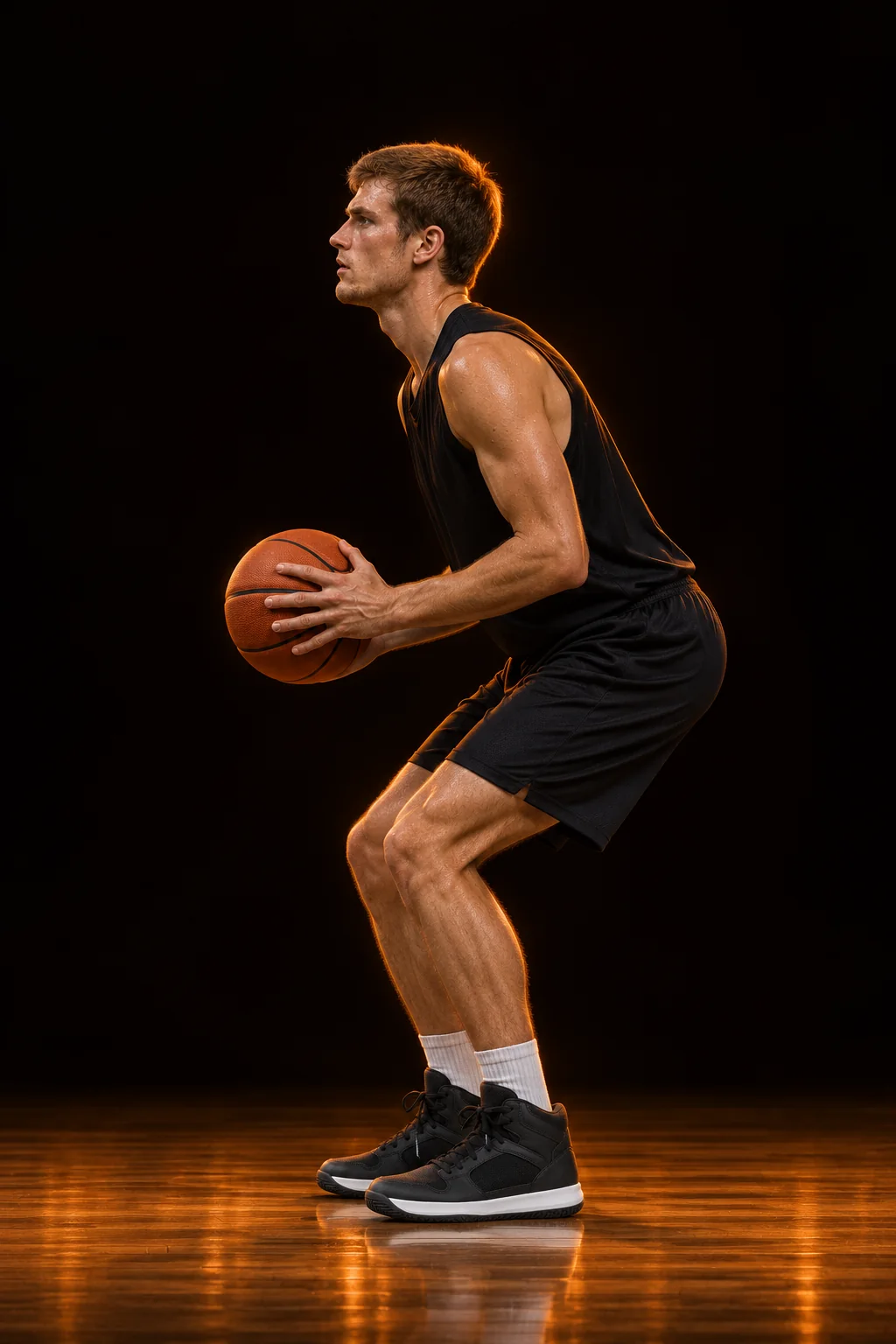
Stand with your feet about shoulder width apart, knees soft, weight on the balls of your feet.
Run the same routine every time
Your routine calms your body and starts your shot at the same rhythm. Pick one and keep it:
- Catch the ball and find the nail with your foot.
- Take the same number of dribbles, two or three.
- Spin the ball to your shooting grip, seam under your fingers.
- Breathe out once and look at the back of the rim.
- Shoot.
Never add a step in a game that you skipped in practice.
Dip, rise and release in one motion
Your legs make the distance, your arm makes the direction. Dip your knees, rise, and let the ball go as your legs straighten, in one smooth motion with no pause at the top. The same knee bend and the same release you use on your jumper work here; read the checkpoints in how to fix your jump shot form.
Keep your elbow under the ball and your wrist relaxed. Push up through the ball and snap your wrist so your fingers point at the rim.
Launch at around 52 degrees
Engineers at North Carolina State ran hundreds of thousands of simulated free throws and found the best release for a shooter who lets the ball go 7 ft off the floor: launch at 52 degrees, aim toward the back of the rim, and put up to 3 revolutions a second of backspin on the ball. Backspin softens the ball off the rim, so a slightly long shot still drops.
Your ball comes down a little flatter than it went up. A 52 degree launch drops into the rim at around 45 degrees, steep enough to give your ball about 3 in of room. See the full rim math in how to find your shooting arc.
Hold your follow-through
Keep your arm up, wrist dropped, fingers pointing at the rim, until the ball hits the rim or the net. Your follow-through shows you the miss:
- Fingers point left or right: your hand turned at release. Check your elbow.
- Ball short: your legs quit. Dip deeper.
- Ball long and flat: you pushed from the chest. Release higher and up.
Chase your streak
Percentages hide streaks, and streaks show your routine holding up. Try this drill:
- Shoot sets of 10 and write down your makes.
- Keep a running count of makes in a row. Your best streak is your number for the week.
- After each workout block, shoot 2 free throws tired, like a trip to the line in the fourth quarter.
Chart your misses by direction too. Three misses short in a row tell you something one bad set never will.
Practice under pressure
Free throws in a game come tired, after a foul, with people watching. Build that into your practice:
- Two in a row. Shoot until you make two in a row, then run a sprint. Miss the second and start over.
- One and one. Shoot one; make it and you earn a second. Keep a tally of points from 10 trips.
- Game ending. Pick a score, say your team down one with no time left. Make both or run a lap.
- Talk back. Have a friend talk to you while you shoot. Your routine has to hold up through the noise.
Shoot your free throws right after your hardest drills. Your percentage fresh tells you about your stroke; your percentage tired tells you about your game.
Read your misses by direction
Every miss leaves a clue. Write a mark for each one: S for short, L for long, and a small arrow for left or right.
- Mostly short: your legs stop working when you get tired. Dip a touch deeper and finish with your legs straight.
- Mostly long: you push from your shoulder or rush your rhythm. Slow your routine by one dribble and release higher.
- Mostly left or right: your elbow drifts off its line or your feet point away from the rim. Check your stance on the nail and record five free throws front on.
Fix the most common direction first and leave the others for next week.
Keep your rhythm on game day
Use the same number of dribbles, the same breath and the same look at the rim you used in practice. Take your time; the official gives you 10 seconds in most leagues, and you need about five. Miss the first and run your full routine again for the second, as if the first never happened.
Track every free throw
You can keep your makes on paper. Track your free throws with Hoopmaxxing. Tap made or missed after each shot, keep your streak alive and watch your percentage per session; your shot chart and free throws are free. Record your stroke and you also read your dip, your elbow and your release, in degrees, inches and milliseconds.