
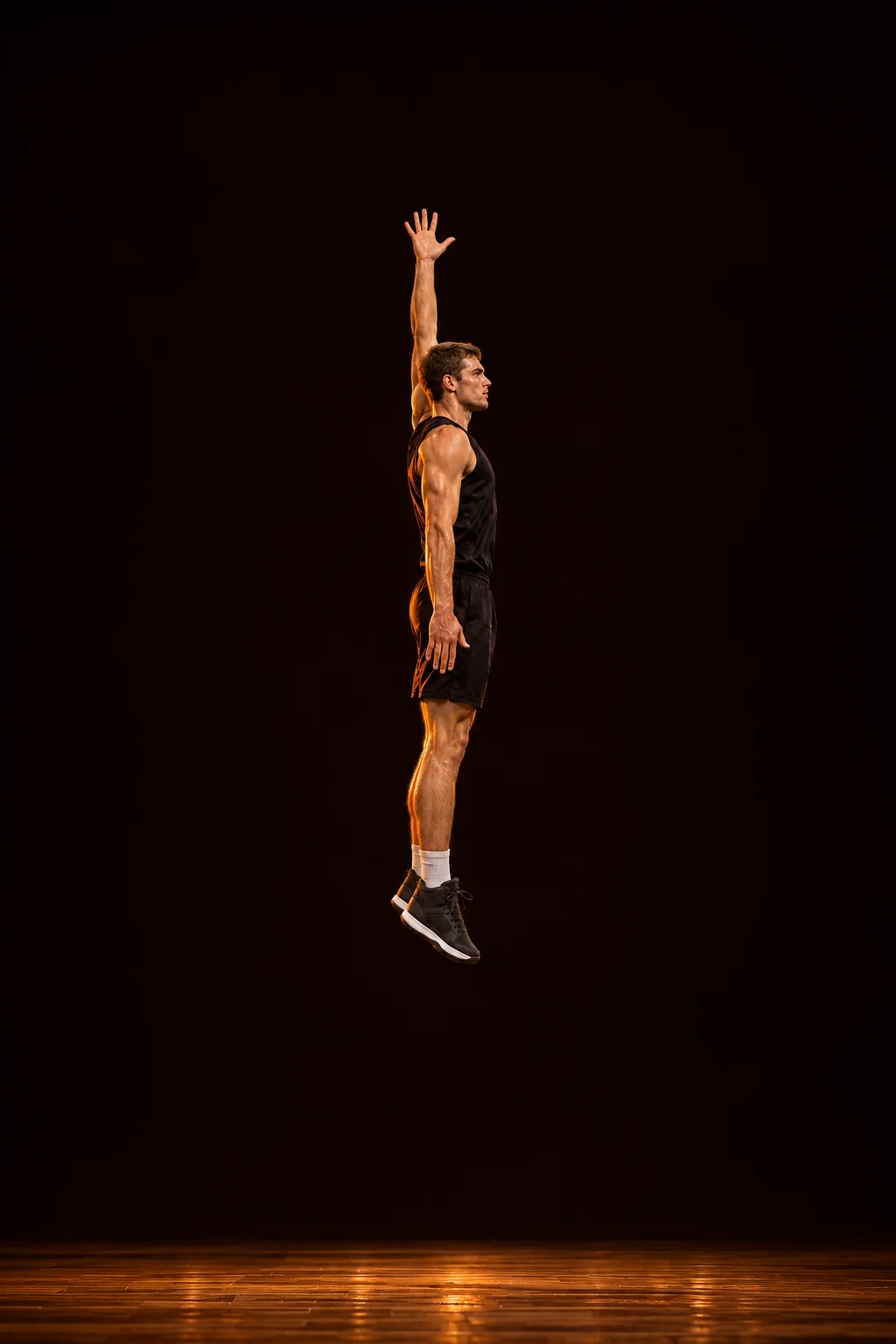
You can add inches to your vertical in six weeks if you train the right things and measure them honestly. Start with a test, train three qualities in order, and retest every second week the same way. Your number tells you what works.
Test your vertical before you start
Film one standing jump from the side at chest height, with your shoes and the floor in the frame. Use slow motion at 120 or 240 frames a second if your phone has it. Find the first frame both feet leave the floor and the first frame a foot comes back down, then turn that hang time into your height with the vertical jump calculator.
The math comes from physics: a body in the air for t seconds rose g × t² ÷ 8. Bosco and colleagues described the flight-time method in 1983, and a phone filming at high speed matched a force plate within about 1 cm on average in a 2015 study of 100 jumps.
Test three jumps, rest a minute between each, and keep your best. Write down your shoes, your floor and your camera spot, and keep them the same for every retest.
Fix your jump before you train it
Most players leave inches on the floor through technique:
- Dip quick. Drop into a quarter squat fast and reverse it right away. A slow, deep sit wastes the stretch in your legs.
- Swing your arms. Drive both arms back on the dip and up hard on the rise. Your arms add lift you get for free, and you test with them every time.
- Jump straight up. Land where you took off. The same habit cleans up your jumper; see how to fix your jump shot form.
Train quick feet in weeks 1 and 2
Quick, low hops teach your ankles and calves to bounce off the floor.
| Drill | Sets | Reps |
|---|---|---|
| Line hops, front and back | 3 | 20 seconds |
| Line hops, side to side | 3 | 20 seconds |
| Pogo jumps, stiff knees | 3 | 15 |
| Jump rope | 3 | 60 seconds |
Stay on the balls of your feet and spend as little time on the floor as you can. Your feet should sound light.
Build strong legs in weeks 3 and 4
Strength raises your ceiling. Two sessions a week:
| Exercise | Sets | Reps |
|---|---|---|
| Goblet or back squat | 4 | 6 |
| Rear-foot elevated split squat | 3 | 8 each leg |
| Romanian deadlift | 3 | 8 |
| Single-leg calf raise | 3 | 12 each leg |
Pick a weight you can lift with clean form and 2 reps left in the tank. Keep your quick-feet work as a warm-up.
Jump with full effort in weeks 5 and 6
Now turn strength into height. Plyometric training works: a 2007 meta-analysis of 26 studies found it raised countermovement jump height by 8.7 percent on average, and by 7.5 percent with an arm swing.
| Drill | Sets | Reps | Rest |
|---|---|---|---|
| Box jumps, step down | 4 | 4 | 90 seconds |
| Approach jumps to touch the rim or backboard | 4 | 3 | 2 minutes |
| Depth drops, stick the landing | 3 | 4 | 90 seconds |
| Broad jumps | 3 | 4 | 90 seconds |
Every rep gets full effort with full rest. Stop the set when your jumps get lower.
Land softly and recover hard
Every jump ends in a landing, and landings carry the load that hurts knees. Land on the balls of your feet, sink your hips back, keep your knees over your toes and hold the landing for a count of two on your first sessions. Quiet landings mean your legs absorb the force.
Recovery makes the gains. Sleep eight hours, eat enough protein across the day, and leave at least one easy day between leg sessions. Playing pickup on your off days counts as jumping: cut a plyometric set when you played hard the day before. Sore enough to change how you walk? Rest that day.
Retest every second week
Test on the same day of the week, fresh, before you train. Same shoes, same floor, same camera spot. Write your best of three. Two weeks without a gain? Sleep more, eat enough protein, and look at your technique again before you add volume.
Work out how far you are from dunking
Add your standing reach to your vertical. Your hand needs to clear the 10 ft rim by about 6 in to hold the ball and throw it down, so a player with an 8 ft standing reach needs about a 30 in jump. Not sure of your reach? Use about 1.33 times your height. The vertical jump calculator shows you the inches you have left.
Stronger legs help your handle too: a lower stance and a faster first step make every drill in the ball handling guide sharper.
Test your vertical in one jump
Counting frames by hand gets old fast. Test your vertical with Hoopmaxxing. Film one jump from the side and your time in the air turns into your height, frame by frame; step either frame yourself to check it, and see how far your hand still is from dunking. Run the six-week Hops Program with a retest every second week. Your vertical test is free.
If you feel pain in your knees, shins or back, stop jumping and see a doctor or a physical therapist.