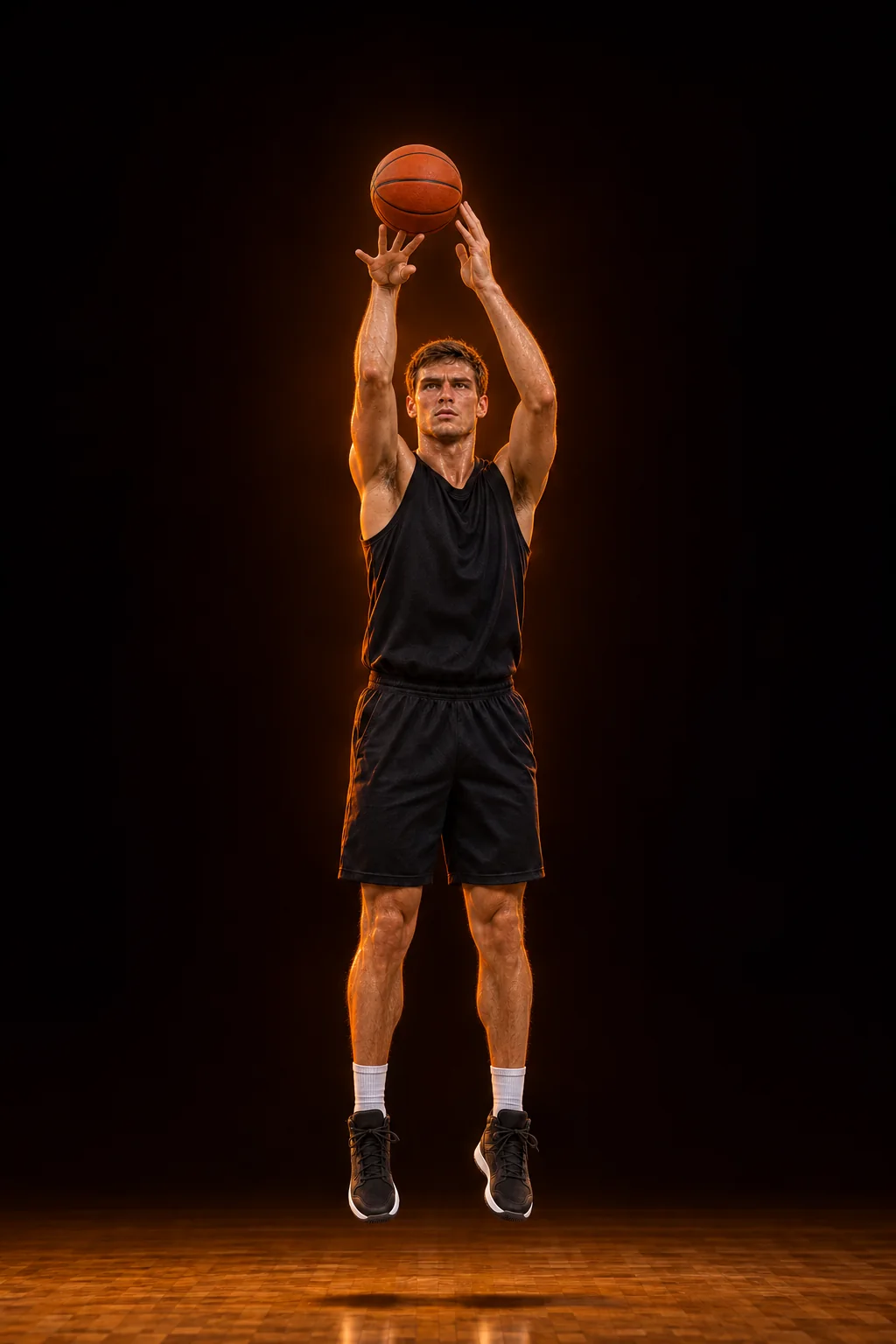
You can shoot 500 jumpers a day and still groove the same miss. You start fixing it when you see your shot from the outside and put a number on each piece of it. These four checkpoints cover the parts of your jumper you can measure with a phone: your dip, your elbow, your release and your landing.
Set up your camera before you shoot
Film each checkpoint from the angle that shows it best.
- Side on, you see your dip and your release against the top of your jump. Stand your phone at chest height on your shooting side, 10 to 15 ft away, square to your shoulders.
- Front on, you see your elbow and your landing. Stand your phone where the rim would see you, a step to the side of the lane so your misses fly past it.
Keep your shoes and the ball above your head in the frame. Shoot 10 shots from one spot before you move, so you compare like with like.
Dip your knees at least 25 degrees
Your legs make your range. Dip stiff, with your knees bent less than about 25 degrees at the bottom of your gather, and your arms push the ball the whole way to the rim. Your shot flattens and your misses run short at the end of a workout.
A 2023 study of two-point and three-point shooters at the University of Kansas filmed 18 players at 30 frames a second: the better shooters rose higher on their release, with more vertical displacement on their threes. You buy that rise in the dip.
Drill: chair dips. Stand a chair behind you, sit back until your seat brushes it, and rise into your shot. Do 3 sets of 10 from 8 ft, then from the free-throw line.
Keep your elbow on the line
Draw a line from your shooting shoulder to your shooting wrist at the set point, where the ball stops before you push. Keep your elbow on that line, or within about 4 in of it. Past that, your elbow points to one side and your ball tends to follow it.
Your elbow flares for one of two reasons:
- You hold the ball in the middle of your body. Move it up over your shooting eye.
- You hold the side of the ball. Spread your fingers behind it, with the seam under your index and middle fingers.
Drill: one-hand form shots. Stand 3 ft from the rim, guide hand behind your back, and shoot with your elbow under the ball. Make 10 in a row with the ball dropping straight through, then step back a foot.
Let it go by the top of your jump
Watch any good shooter in slow motion: the ball leaves the hand at the top of the jump or just before it. Shoot after the top and your hips start to fall while your arms push up, so you need a different amount of arm on every shot. You see it as a miss long, then a miss short.
Use a simple number: let the ball leave your hand no more than 60 ms after your hips reach their highest point. At 30 frames a second, you get less than two frames. Side on, step through your clip frame by frame, find the frame where your hips peak and the frame where the ball leaves your fingers, and count.
Drill: quick release. Have a partner pass to you from under the rim. Catch, dip and shoot in one motion, and try to let it go before you feel yourself hang. Do 5 sets of 5 from your favorite spot.
Land where you took off
Your landing tells the truth about your jump. Front on, measure how far your feet land from your take-off spot. Within 6 in, you jumped straight up. Past that, you drift, and the ball drifts with you. Side on, you judge depth less precisely, so allow about 12 in.
You drift because of three habits:
- You point your feet away from the rim. Turn both toes toward the rim before the catch.
- You fade on purpose. Keep your fadeaway for games and out of your form work.
- You shoot off the move. Coming off a screen, your momentum carries you. Plant your inside foot first and stop it before you rise.
Drill: tape the X. Tape an X on the floor and shoot 50 corner threes with your toes on it. Count only the makes where you land on the tape.
Fix one checkpoint at a time
Pick the checkpoint furthest past its line and work only on that one for a week. Try to fix your dip and your landing together and you usually fix neither. When your number comes back inside the line on three sessions in a row, move to the next one.
Check your arc next: a clean release angle gives your ball more room at the rim. Read how to find your shooting arc, then take the same four checkpoints to the line with how to make more free throws.
Measure your shot on every session
You can count frames by hand in any video app. Measure your jumper with Hoopmaxxing. Record your shots side on or front on and you read your release against the top of your jump in milliseconds, your landing in inches, your elbow off its line and your dip in degrees, with the fix that costs you the most makes first. Enter your height once and every inch scales to you.
Training your legs for more lift? Run the plan in how to jump higher and check your takeoff with the vertical jump calculator.